
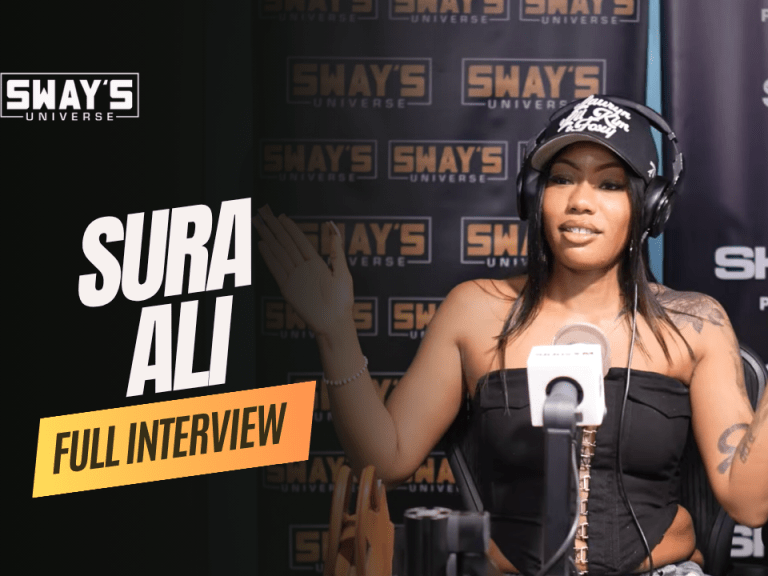
Sura Ali, the Brooklyn-born rapper and spoken word artist known for her standout run on Netflix‘s Rhythm and Flow Season 2, made her first appearance on Sway in the Morning on Shade 45 in June 2026. In a 31-minute interview, she discussed her roots in African spirituality, her journey across the U.S., and why penmanship—not viral moments—defines her artistry.
Some artists walk into a room and fill it. Sura Ali walks into a room and changes it.
That’s the consensus from everyone who witnessed her first-ever appearance on Sway in the Morning, Shade 45’s flagship hip-hop interview show hosted by Sway Calloway. Joined by Mike Muse, Tracy G, radio personality Miabelle, and legendary hip-hop journalist Jayson Rodriguez, the studio session quickly became more than a standard interview. It became a masterclass in what authentic artistry looks like in 2026.
Sura Ali isn’t new to the spotlight. Her run on Netflix’s Rhythm and Flow Season 2 turned heads across the globe, earning her fans from Cleveland to California. But for many listeners tuning into Shade 45 that morning, this was their first real introduction to the woman behind the bars—and she did not disappoint.
What followed was nearly 32 minutes of raw conversation, live performance, and spoken word poetry that left the entire studio on its feet. Here’s a full breakdown of everything that went down.
A Journey Through the Five Boroughs and Beyond
Sura Ali was born in Brooklyn, but Brooklyn is just the beginning of her story.
By her own account, she’s lived in Harlem (twice), Mississippi, and Maine—not by choice, but because she was “sent away” as a youth. Not for being bad, she’s quick to clarify, but for being different. “I was just the different, that’s it,” she told Sway during the interview.
Those early displacements, rather than holding her back, became the foundation of her worldview. Living in the deep South and the rural North exposed her to the universality of the Black experience across America—and the consistency of systemic racism regardless of geography. “If you go far up north, you go far down south, it’s the same,” she said.
That perspective seeps into everything she writes.
What Does the Name “Sura Ali” Actually Mean?
The name carries more weight than most people realize. While “Surah” is widely recognized as a chapter in the Quran, Sura Ali points to a deeper layer: the “Ra” in her name connects to Ra, the ancient Egyptian sun god—a symbol of light.
“It’s really about light for me,” she explained. “I bring light wherever I go.”
That duality—spiritual discipline rooted in African ancestry, combined with a radiant, almost magnetic energy—defines both her presence and her pen.
Spirituality as a Protective Force
One of the most powerful segments of the interview touched on how Sura was raised.
Growing up in a household grounded in African spirituality and Afrocentricity, she was surrounded by Yoruba priestesses and a strong sense of Black power and cultural identity. While she has Muslim family members and attended Muslim camps as a child, her core spiritual foundation remains tied to her ancestors.
She describes that connection as a “cape”—something that protects her as she moves through the world. “My ancestors are heavy on my back,” she said, framing her success not as an individual achievement but as a collective one carried forward by those who came before her.
In an industry that often strips artists of depth, this rootedness sets Sura Ali apart.
Why Sura Ali Calls Herself the Voice for the Voiceless
When Sura Ali picks up a pen, she isn’t writing her own diary. She’s writing for her community.
“I feel like I’ve always said that I feel like I’m the voice for people that are afraid to speak,” she told the crew. “They think that it’s nobody that could relate with them until they hear my [music]—and they like, ‘Oh, I feel that. I know that. Like that’s my life.'”
This philosophy drives three distinct elements of her artistry:
- Channeling collective energy: Even when she hasn’t personally experienced a specific struggle, she feels it through the people around her and translates that pain into her music.
- Creating relatability: Her goal is to make listeners feel less alone in their trials—to hear their own story reflected back at them through her words.
- Committing to authenticity: Sura doesn’t perform emotion. She excavates it.
That commitment surfaced clearly during her live studio performance, where she delivered bars sharp enough to stop the entire room cold. Sway called it out directly: “Bars, stories, similes, metaphors.”
What Miabelle and Jayson Rodriguez See in Sura Ali
Having the talent is one thing. Having industry veterans vouch for you with conviction is another.
Miabelle, a prominent radio personality at Hot 97 (Monday–Friday, 6–10 a.m.) and a new collaborator with SiriusXM and Soundcloud, described Sura’s presence as immediately undeniable. “She opens her mouth and she has the voice quality,” Miabelle said. “It’s believable in all spheres—rap, spoken word, everything.” Beyond the technical skill, Mia emphasized Sura’s consciousness as a Black woman and her authentic commitment to supporting women’s freedom and self-expression.
Jayson Rodriguez, who has interviewed Drake, Eminem, DMX, Nicki Minaj, and Wiz Khalifa throughout his celebrated career, zeroed in on something more fundamental. Hip-hop trends come and go, he noted, but one thing never changes: penmanship matters.
“Underneath everything—delivery, package, everything—it’s still the penmanship,” Rodriguez said. “And when you listen to her, you hear it. It comes through.”
Their belief in her isn’t casual enthusiasm. It’s the kind of steadfast conviction that comes from having seen hundreds of artists and knowing—immediately—when someone is the real thing.
The Live Studio Performance: What Happened When the Beat Dropped
If the conversation alone was compelling, the performance was a revelation.
When the backing track wasn’t ready, Sura didn’t hesitate. She started rapping over nothing, commanding the room with the same energy she’d bring to a sold-out stage. Mike Muse called it on the spot: “That is a sign of a star.”
Her lyrics weren’t surface-level flexing. Lines like “I’ll be staring at the demons that I’m facing / It’s a heavy conversation” and “I’ve been feeling down so long, I don’t know which way is up” reflect an artist willing to go to uncomfortable places in service of truth.
She also touched on themes of fake love, discernment, loyalty, and the relentless grind of someone who isn’t chasing clout—she’s chasing a legacy.
“Black Bodies”: A Spoken Word Performance That Stopped the Room
Near the end of the interview, Sura Ali delivered an a cappella spoken word piece titled “Black Bodies.”
The poem confronts police brutality, systemic racism, and the political reality of existing as a Black person in America with a rawness that’s difficult to describe. She prefaced it plainly: “When you’re Black, everything is politics. How you look, how you act, the way you dress, the school you go to.”
What followed left the entire studio speechless. The team stood. Sway called it “powerful.” Jayson Rodriguez said it spoke to his spirit.
“Black Bodies” isn’t just a poem. It’s proof that Sura Ali’s spoken word roots—which she began developing in 2015 at college in upstate New York after being inspired by a visiting poet—are every bit as formidable as her rap skills.
Rhythm and Flow, Public Scrutiny, and Learning to Be Seen
Sura Ali’s run on Netflix’s Rhythm and Flow Season 2 introduced her to a global audience. But visibility is a double-edged sword.
She spoke openly about the experience of being both loved and criticized by people who only saw a fraction of who she is. “They know a small portion of what they seen on TV,” she said. “They don’t even know how it is living in America, or being from New York, or being a woman with a voice.”
She was candid about losing sleep over the criticism at first. But she arrived at a perspective that reflects real growth: “The spectrum of love and hate is literally on the same thing. Just as much energy as it take for you to hate me—them same people is still going on my page.”
She’s turned the scrutiny into a metric. The hate and the love both feed the algorithm. More importantly, they don’t define her.
What Makes Sura Ali Different From the Current Crop
It comes down to three things: roots, range, and realness.
Her roots in African spirituality and her lived experiences across America give her a depth of perspective that most artists can’t manufacture. Her range—from high-energy rap to quiet, devastating spoken word—makes her genuinely versatile in a way the industry rarely sees. And her realness isn’t a brand position. It’s just who she is.
She wears a hat bearing the names Lauryn Hill, Lil Kim, and Foxy Brown—a nod to the lineage she respects without trying to replicate. She’s clear-eyed about what she owes to the women who came before her, and equally clear about carving her own lane.
Sura Ali Is Just Getting Started
As the interview wrapped, Sway extended an open invitation—come back anytime, including for a potential BET appearance on the horizon with Raheem DeVaughn also mentioned.
Sura Ali showed up to Shade 45 for the first time and left with the entire room converted. Not through hype, not through performance, but through the thing Jayson Rodriguez keeps coming back to: penmanship. Real craft. The kind that doesn’t need a trend to justify its existence.
She’s not waiting for the industry to make space for her. She’s making her own.
Watch the full interview:
Frequently Asked Questions
Who is Sura Ali?
Sura Ali is a Brooklyn-born rapper, MC, and spoken word poet known for her appearance on Netflix’s Rhythm and Flow Season 2. She is recognized for her raw lyricism, deep roots in African spirituality, and her commitment to representing her community through her art.
What is Sway in the Morning?
Sway in the Morning is a hip-hop interview and radio show hosted by Sway Calloway on Shade 45, a SiriusXM channel. The show is known for spotlighting both established artists and emerging talent across hip-hop and R&B.
What did Sura Ali perform on Sway in the Morning?
Sura Ali delivered two performances during her June 2026 appearance: a live rap performance demonstrating her technical skill and storytelling ability, and an a cappella spoken word piece titled “Black Bodies,” which addresses police brutality and the Black experience in America.
What does the name Sura Ali mean?
Sura Ali connects to multiple cultural and spiritual traditions. “Surah” refers to a chapter in the Quran, while “Ra” connects to the ancient Egyptian sun god, symbolizing light. Sura Ali has described her name as fundamentally about bringing light wherever she goes.
What is Sura Ali’s spiritual background?
Sura Ali was raised in a household grounded in African spirituality and Afrocentricity, surrounded by Yoruba priestesses. While she has Muslim family members and attended Muslim camps as a child, her core spiritual identity is rooted in her ancestral and African spiritual traditions.
Why do industry veterans Miabelle and Jayson Rodriguez support Sura Ali?
Miabelle highlights Sura Ali’s undeniable stage presence, voice quality, and consciousness as a Black woman. Jayson Rodriguez, who has interviewed artists including Drake, Eminem, and DMX, points to her penmanship—the quality of her writing—as the defining factor that sets her apart from her peers.