
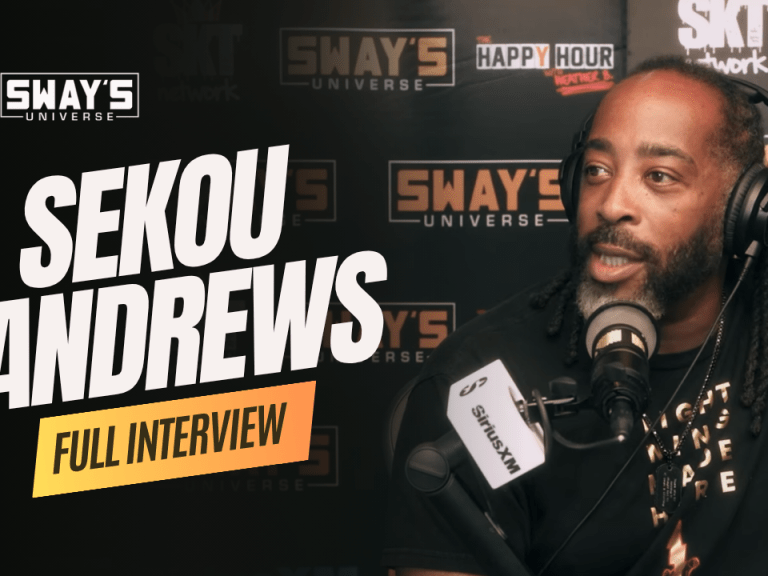
When a guest walks into a room and receives a standing ovation before they even speak, you know you are in the presence of someone special. That was the energy when Sekou Andrews sat down to discuss his journey, his craft, and his mission to revolutionize the world of spoken word. A two-time national poetry slam champion, a Grammy-nominated artist, and an internationally acclaimed creator, Sekou has spent decades proving that poetry is not just a niche art form, it is a powerful, multi-dimensional force capable of move millions.
For those who think spoken word is a linear, one-dimensional medium, Sekou is here to challenge that perception. As he explains, the voice is an instrument that requires the sounds surrounding it to “show up and show out” just to keep pace with the power of the message. From performing for Barack Obama in Oprah Winfrey’s backyard to collaborating with stars like Jordin Sparks and Omari Hardwick, Sekou has built a career that defies the “broke poet” stereotype and creates a new blueprint for creative success.
From the Bay to DC: The Origin Story
Sekou’s journey is a tapestry of cultural hubs. He began in the Bay Area, specifically Berkeley and Hayward, coming up during an era defined by the legendary Hieroglyphics crew and artists like Pep Love and Casual. This foundation in West Coast hip-hop culture shaped his rhythmic sensibilities and his DIY work ethic.
However, his path took a significant turn when his mother moved to Washington, D.C., to teach at Howard University. It was in the nation’s capital that Sekou fell in love with performance. Attending the Duke Ellington School of the Arts and later Georgetown Day, he discovered the twin passions of acting and hip-hop. By the time he moved to Los Angeles for college at Pitzer, he was ready to chase the dream of becoming a recording artist.
The Struggle with the “Formula”
Like many visionary artists, Sekou found himself at odds with the music industry’s rigid expectations. Label executives would praise his demos but ultimately pass because his work didn’t fit the “formula”, the violent or hyper-materialistic tropes that dominated hip-hop at the time.
“I got tired of hearing that,” Sekou recalls. Inspired by the MC Hammer model of independent success (the “Busted Records” DIY approach), he decided to build his own platform. He founded Blind Faith Records and began frequenting spoken word open mics, but with a twist: he brought his hip-hop background with him.
Breaking the Cadence: How Hip-Hop Became Poetry
One of the most profound shifts in Sekou’s career happened when he decided to “free himself” from the traditional hip-hop cadence. He noticed that many MCs remained locked into a specific rhythm even when there was no beat behind them. By breaking that structure, he allowed the audience to have a different relationship with his words.
Instead of rushing through rhymes to fit a 4/4 beat, he slowed down, emphasized the imagery, and let the emotion breathe. This transition allowed his name to grow on the scene, bridging the gap between the grit of hip-hop and the soul-stirring depth of poetry. He wasn’t just rapping anymore; he was resonating.
The Choice: Law School vs. The Life of a Poet
Despite his growing success on stage, the pressure to pursue a “stable” career was ever-present. With a self-described “gift of gab,” Sekou was headed toward a career as an entertainment attorney at Hastings Law School. However, a moment of clarity stopped him in his tracks. He realized he didn’t want to be the person negotiating deals for other entertainers while secretly wishing he was the one on stage.
He pivoted, spending four years as a fifth-grade teacher in South Central Los Angeles. It was during this time that he “accidentally” fell in love with spoken word poetry as a full-time calling. But choosing poetry meant facing a harsh reality: the industry lacked the infrastructure of the music or film worlds.
Refusing to be the “Broke Poet”
Sekou famously jokes that he left a multi-billion dollar industry (law/music) for a “multi-hundred dollar industry.” There were no agents, no unions, and no labels for poets. He often saw poets performing for “exposure” on national television shows where everyone else, from the DJ to the bouncer, was getting paid.
Instead of accepting this, Sekou leaned into his entrepreneurial spirit. He realized that if there was no path, he had to create one. This led to a career focused on:
- Monetizing the Art: Finding ways to bring poetry into corporate spaces like Google, Nike, and Amazon.
- Increasing Perceived Value: Refusing to perform for free and demanding the same respect as any other headlining artist.
- Building Infrastructure: Creating a “machine” for success where none existed.
Collaborations and “Kukumi”
Sekou’s latest project, Kukumi, is a testament to his ability to blend spoken word with soul, hip-hop, and afrobeat. The project features incredible collaborations, including the soulful vocals of Jordin Sparks on “Love Don’t Care.” Sekou notes that their partnership grew naturally from their time serving together on the board of the Recording Academy’s LA Chapter.
Another key collaborator is Omari Hardwick (famously known as “Ghost” from Power). While the world knows Omari as a star actor and former football player, Sekou knows him as a brother from the Poetry Lounge in LA. They “cut their teeth” together on slam teams, proving that the foundation of poetry can lead to greatness in any field of entertainment.
Key Takeaways for Aspiring Creators
- Don’t Be Afraid to Pivot: Sekou moved from football to hip-hop to law to teaching before finding his true calling in poetry. Every step informed his ultimate success.
- The DIY Mindset: If the “gatekeepers” say your work doesn’t fit the formula, build your own door. Use the tools available to create your own label or platform.
- Value Your Craft: Avoid the trap of “exposure.” Build a business mindset around your art to ensure it is sustainable long-term.
- Master Your Instrument: Whether it’s the cadence of your voice or the sounds you surround yourself with, ensure your technical skill matches the power of your message.
The Future of Spoken Word
Sekou Andrews is more than a poet; he is a pioneer who has spent his career bringing poetry to places where it was previously dismissed. By combining cinematic storytelling with a relentless entrepreneurial drive, he has elevated the spoken word from the back corners of coffee shops to the biggest stages in the world.
As he continues to push the boundaries with projects like Kukumi and his work with The Poetry Lounge (which is currently seeking a permanent home in Leimert Park), Sekou remains a shining example of what happens when you refuse to be put in a box. He didn’t just find his voice, he used it to build a legacy.