
If you have been looking for your next television obsession, look no further than Beauty in Black. For many fans, this series has become the ultimate “fix” in the wake of shows like P Valley. It is dramatic, over-the-top, and unapologetically real. But what truly makes the series shine is its ensemble cast. In Beauty in Black, every actor brings “main character energy” to the screen, allowing the audience to identify with and be captivated by every role equally.
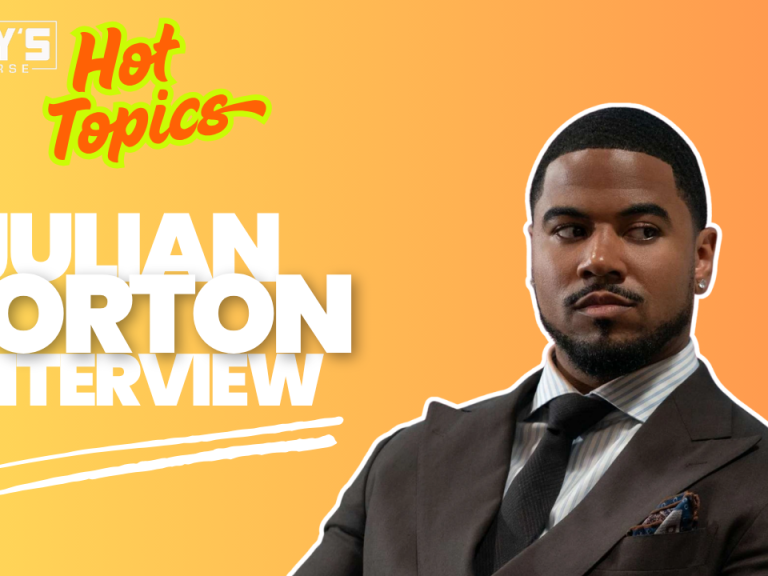
One of the most standout—and polarizing—characters in the series is Roy. Played with a chilling intensity, Roy is the man everyone loves to hate. In a recent candid conversation, actor Julian Horton opened up about what it takes to embody such a vicious villain, the real-life “hustle” that prepared him for stardom, and how he manages to leave Roy’s aggression on the set once the cameras stop rolling.
From Selling Plasma to Netflix Stardom
Before Julian Horton was the face of a number one trending series on Netflix, he was a man familiar with the grind. Recently, a story about Julian’s days as an Uber driver went viral, but as he explains, that was actually “luxury” compared to where he started. Julian’s journey to success is a testament to the power of the hustle.
To make ends meet while pursuing his dreams, Julian didn’t just drive for Uber. He was selling plasma for $100 a pop, moving furniture, working at Verizon, and even selling DIRECTV in the back of Walmart. He describes his life as a series of experiences that “funnel” into the next big thing. Every struggle and every odd job provided him with the emotional storage he now uses to make his characters feel authentic.
“Everything that has happened in my life is already stored up emotionally,” Julian shares. This depth of experience allows him to tap into the “iron sharpens iron” mentality, where the ups and downs of life have made him a stronger, more capable performer.
Tapping Into the Villain: The Psychology of Roy
Playing a character as aggressive and unhinged as Roy requires a specific kind of emotional access. Julian admits that while he is a believer who seeks peace and love in his personal life, he is no stranger to the darker emotions that Roy inhabits. He has felt anger, anxiety, and depression—the difference lies in how those emotions are processed.
The Moral Contrast
Julian explains that the primary difference between himself and Roy is their “nurturer.” While Julian turns to prayer, meditation, and his faith in God and the Holy Spirit to find fulfillment, Roy takes a different path. Roy turns to “the craziness”—the coke, the power struggles, and the mistreatment of women—to fill the void inside him. Because Julian has felt these raw emotions in his own life, it is easy for him to “tap in” to Roy’s headspace, even if their actions are polar opposites.
The Billy Bob Thornton Approach
When asked about his acting method, Julian points to legendary actor Billy Bob Thornton as an inspiration. He appreciates the “raw” and “what you see is what you get” style of performance. Julian isn’t the type of actor who needs elaborate rituals, meditation rooms, or finger-snapping triggers to find his character. Instead, he believes the character already “lives on him” because of his life experiences. When he sees the script, he knows what needs to be done, and he gets it done.
The “Pads Off” Philosophy: Separating the Actor from the Role
With a character as intense as Roy, many fans wonder if Julian has to perform a mental “exorcism” to get back to himself after a day of filming. Surprisingly, Julian finds the separation quite easy. He views acting as a professional job—one he has been honing since he was five years old, playing with a camcorder alongside his four siblings.
He uses a sports analogy to describe his process: “It’s like hooping or playing sports. Once I take the pads off, I don’t want to tackle nobody.” For Julian, the “action” only exists between the lines of the script. Once the director yells “cut,” he is back to joking, goofing around, and spreading positivity. This ability to switch off the aggression allows him to maintain his mental health and keep the work from taking a heavy toll on his personal life.
Collaborating with Tyler Perry: Freedom and Risk-Taking
A major factor in the success of Roy as a character is the creative freedom provided by Tyler Perry. Julian notes that Roy was written as a fluid, free character, which allowed him to input some of his own animated personality traits into the role. Instead of being a “one-note” villain, Roy has layers, and sometimes even a dark sense of humor.
Julian credits Tyler Perry for not putting him in a “box.” From day one, Perry saw the type of actor Julian was and allowed him to take risks. Many of the “quotables” that fans are now repeating on social media were actually ideas Julian had on the fly. This collaborative environment elevated Roy from a standard antagonist to a complex, memorable “alternate Julian.”
Key Takeaways from Julian Horton’s Journey
- The Hustle is Preparation: Whether it’s selling plasma or working retail, every life experience adds to your “emotional bank” for future success.
- Professionalism Matters: Treating acting as a job allows for a healthy separation between a dark character and your real-life persona.
- Creative Freedom Breeds Excellence: When creators trust actors to take risks, it leads to more authentic and “quotable” performances.
- Faith as a Foundation: Having a strong internal compass (like Julian’s faith) can help an artist navigate playing even the most “unhinged” roles without losing themselves.
Conclusion
Julian Horton’s portrayal of Roy in Beauty in Black is a masterclass in channeled aggression and complex villainy. By drawing from a life of genuine struggle and a deep well of emotional experience, Julian has created a character that feels terrifyingly real. Yet, his ability to step out of those “pads” and return to a life of positivity and faith is what makes him a truly remarkable talent.
As the series continues to captivate audiences, one thing is clear: Roy is one of the most “punk” and unhinged characters on television today. Whether you love him or hate him, you can’t take your eyes off him. Julian Horton is proof that with enough hustle, a bit of risk-taking, and a lot of heart, you can turn a viral Uber story into a career-defining performance.